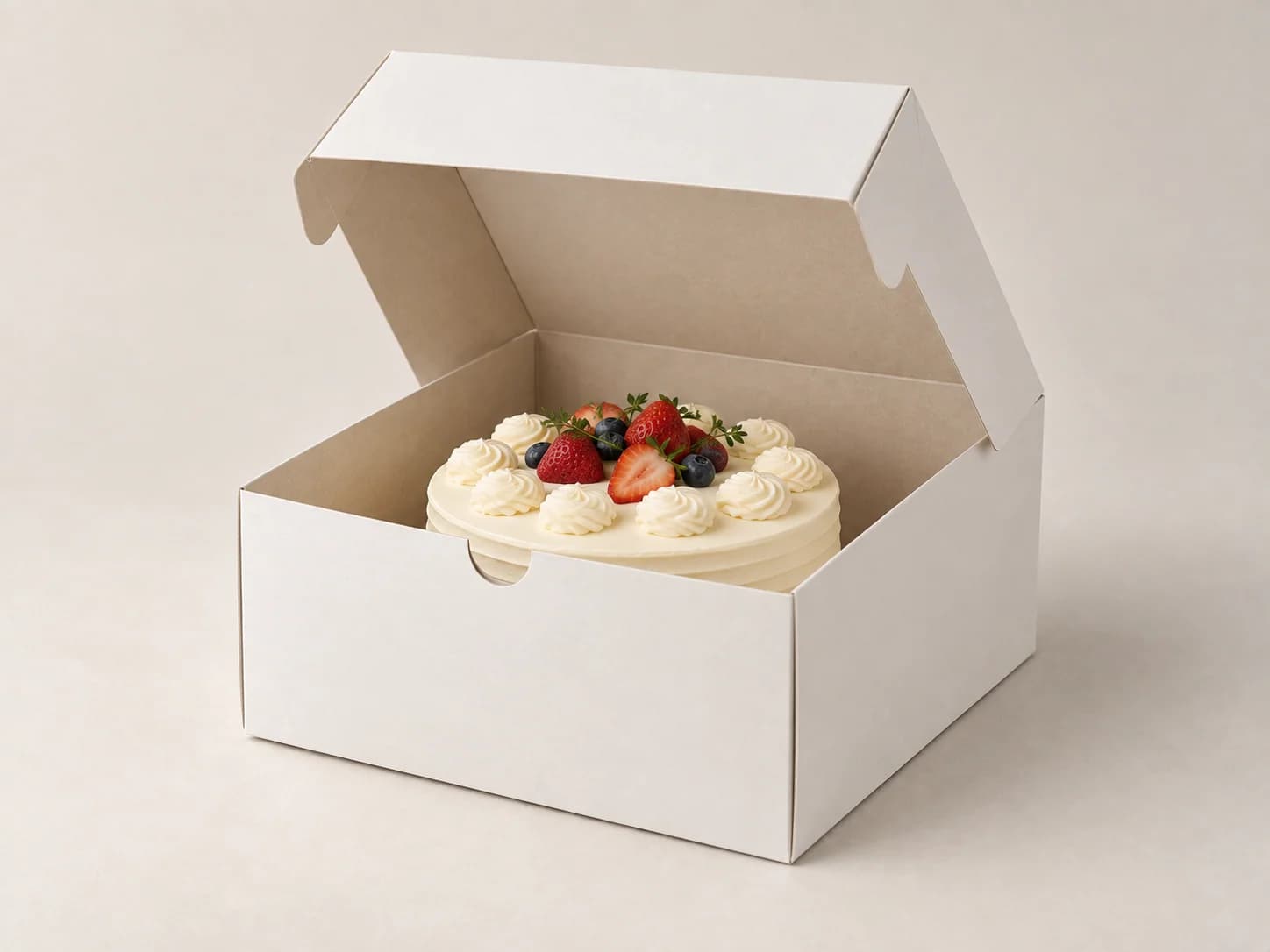
A cake box needs to fit the complete presentation: cake, decoration and support board. Kehong develops custom cake boxes around that packed set, with window, tall-box and carry-handle formats to review for bakery counters, celebration gifting and delivery.
Choose a box around how the cake is packed
A window helps customers see the decoration without opening the lid; decide which part of the cake should remain visible and where the brand artwork belongs. A tall box gives extra room for toppers and raised decoration, but its opening must also allow the cake to enter without touching the sides.
A carry handle can simplify a short collection journey. Review the handle attachment and the loaded box together: a handle is not a substitute for supporting the cake from underneath. Compare lifting the cake through the top with sliding the board through a wider opening before choosing the assembly.
Fit the cake, board and usable inside height
Start with the outside dimensions of the board or drum, including any projecting edge. Record the cake's widest decoration as well as its diameter. The closed box needs space for loading and removal, while excessive movement around the board can be undesirable during handling.
Measure the finished height from the underside of the board to the highest decoration. The thickness of a cake drum, a topper and inward-folding lid parts all affect the usable height. Identify dimensions as internal or external on the drawing; the same nominal box size can have a different clear opening.
Plan the window, artwork and matching components
Review window position, handle location, opening direction, printed panels and paper appearance as one layout. Keep important logos and small text away from folds, cuts and window edges. Compare the artwork on the intended surface and inspect the assembled box, where a graphic may cross several panels.
A cake board provides the presentation base; a thicker cake drum changes the height and support arrangement. Cupcakes need a different insert layout, with openings matched to the cup and clearance above the icing. Select these components with their corresponding box rather than assuming one insert fits every bakery format.
Check the actual storage and delivery conditions
Describe whether the packed cake will be refrigerated, carried by hand or transported in a delivery vehicle, and whether condensation or an intermediate outer carton is expected. Review the box, window and board under those conditions. Paper appearance alone does not establish suitability for a food-contact surface.
Use a representative cake or equivalent packed sample to check closing, lifting, removal and movement during the intended journey. Record where the food touches the packaging, the expected contact time and temperature, and the destination market when assessing the material documentation.
Move from a brief to an approved sample
Prepare the packed-set dimensions, opening preference, artwork coverage, quantity range and destination. Existing reference samples, if available, help compare formats; a project-specific structural sample checks your fit. A printed sample or proof addresses a separate question: appearance on the selected surface.
Record the approved board, box dimensions, window and handle details, artwork version and packing method together. Confirm how the empty boxes are supplied, units per bundle or carton and protection in shipment. Structure, material combination, print setup and order quantity affect quotation, minimum order and timing, so these are agreed for the reviewed specification.