
By / Published by: Foshan Kehong Paper Products Co., Ltd. ·
Reducing the number of box types can look attractive, but a shared box creates a new question: how will each product be located, identified and removed? Compare the complete combinations before deciding what to standardise.
Explore the shared-box examples
1. Define what is actually shared
Here, different products are packed separately into the same type of product carton. They are not packed together as a set, and the carton is not the transport outer case. Each product can still need its own insert.
Sharing dimensions or a dieline, sharing a material and structure, and sharing the same finished printed stock are three different decisions. Two cartons with the same dimensions but different artwork may remain separate inventory items. State which level is being compared.
2. Compare complete options, without a generic winner
Put the proposed product-specific cartons and the shared carton against the same product list. Record unknowns as ‘To confirm’, rather than turning an unmeasured factor into a score.
| Decision | Separate carton + insert per product | Shared carton + product-matched inserts |
|---|---|---|
| Product envelope and orientation | Review each product's full outline and orientation | Review the combined range while keeping each required orientation |
| Movement and sensitive features | Locate each product within its own combination | Define a different locating arrangement where each product needs it |
| Removal | Check access for each carton and product | Check finger access and withdrawal for every insert version |
| Assembly and identification | Identify the correct carton and insert pair | Identify the product, insert and orientation despite the common carton |
| Material types and stock | Count distinct carton and insert versions | Count the truly identical carton stock and remaining insert versions |
3. Two hypothetical combinations lead to different questions
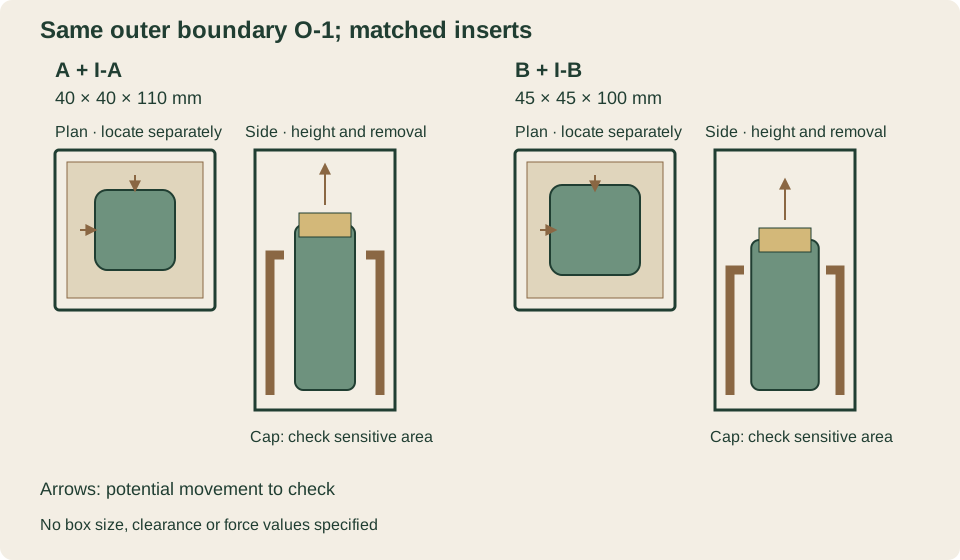
Combination one: two small containers have fixed display orientations and outside envelopes, including their caps, of 40 × 40 × 110 mm and 45 × 45 × 100 mm. Each box holds only one product. Assume identical outer-box artwork and separate inserts I-A and I-B. This is a useful candidate for a shared-box sampling comparison.
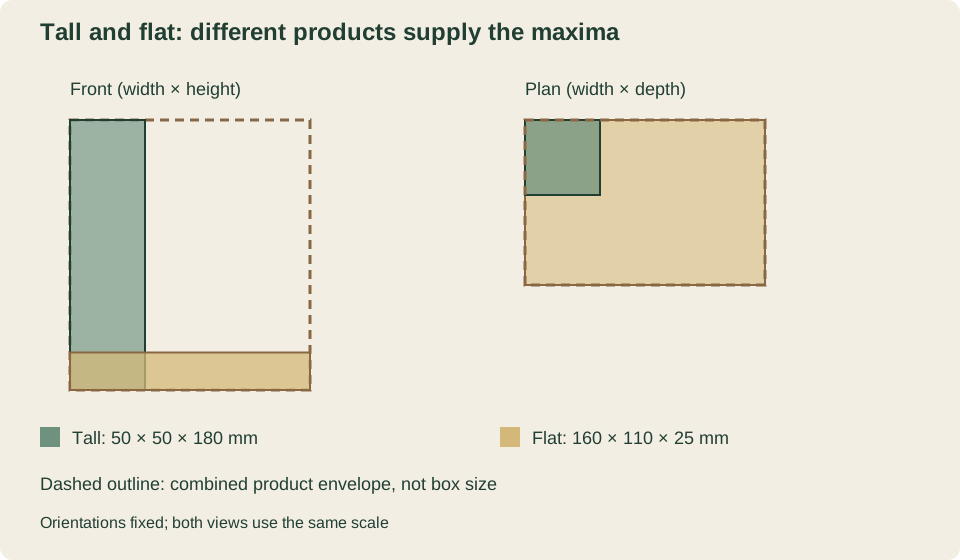
The per-axis maximum, 45 × 45 × 110 mm, is a product envelope, not the box's internal dimensions. Structure, locating features and removal space still need review. Neither fitting inside a common outline nor reducing a carton type establishes compatibility or savings.
Combination two: a tall product measures 50 × 50 × 180 mm and a flat product 160 × 110 × 25 mm, with orientations fixed for this example. Different products supply the maximum dimensions in different directions. Compare excess space, locating arrangements and presentation before standardising. Separate designs are a sensible starting point here; this is not a conclusion that a shared design is technically impossible.
4. Keep the product-to-pack mapping explicit
A common outer box does not remove insert control. Identify the insert version and packing orientation for each product, and keep different printed box revisions separate where they are not identical.
A small counting example: two outer-box types plus two inserts make four material types. If the outer boxes become one completely identical printed item, one box plus two inserts makes three types. This describes only that assumed item count; it does not predict stock value, MOQ or cost.
| Product | Outer box | Insert | Assembly orientation |
|---|---|---|---|
| A | O-1 | I-A | Cap up; reference view A |
| B | O-1 | I-B | Cap up; reference view B |
5. Confirm each combination separately
For every proposed pairing, load the actual product, close the carton, remove the product and run the intended assembly sequence. Record sensitive contact points and incorrect-insert risks on the matching revision. A result for one product and insert does not automatically apply to another.
Fit and operation checks are separate from distribution performance. ISTA procedures consider the product-and-package system; choose any further evaluation for the actual combination and journey. A product fitting inside a carton is not a transport-test result.
Technical references
Describe the options you need to compare
Start with the product, intended use and open questions. Confirm the structure and delivery state for the project.
Discuss the options