
01Factory Knowledge

Why Box Dimensions Change After Material and Structure Selection

Understand why internal and external box sizes, scores, inserts and clearances must be confirmed after board and structure are selected.

Buyer decision supportFoshan, Guangdong, China

Paper box structure diagram showing folded panels and dimensional relationships

Direct answer

What should a buyer know first?

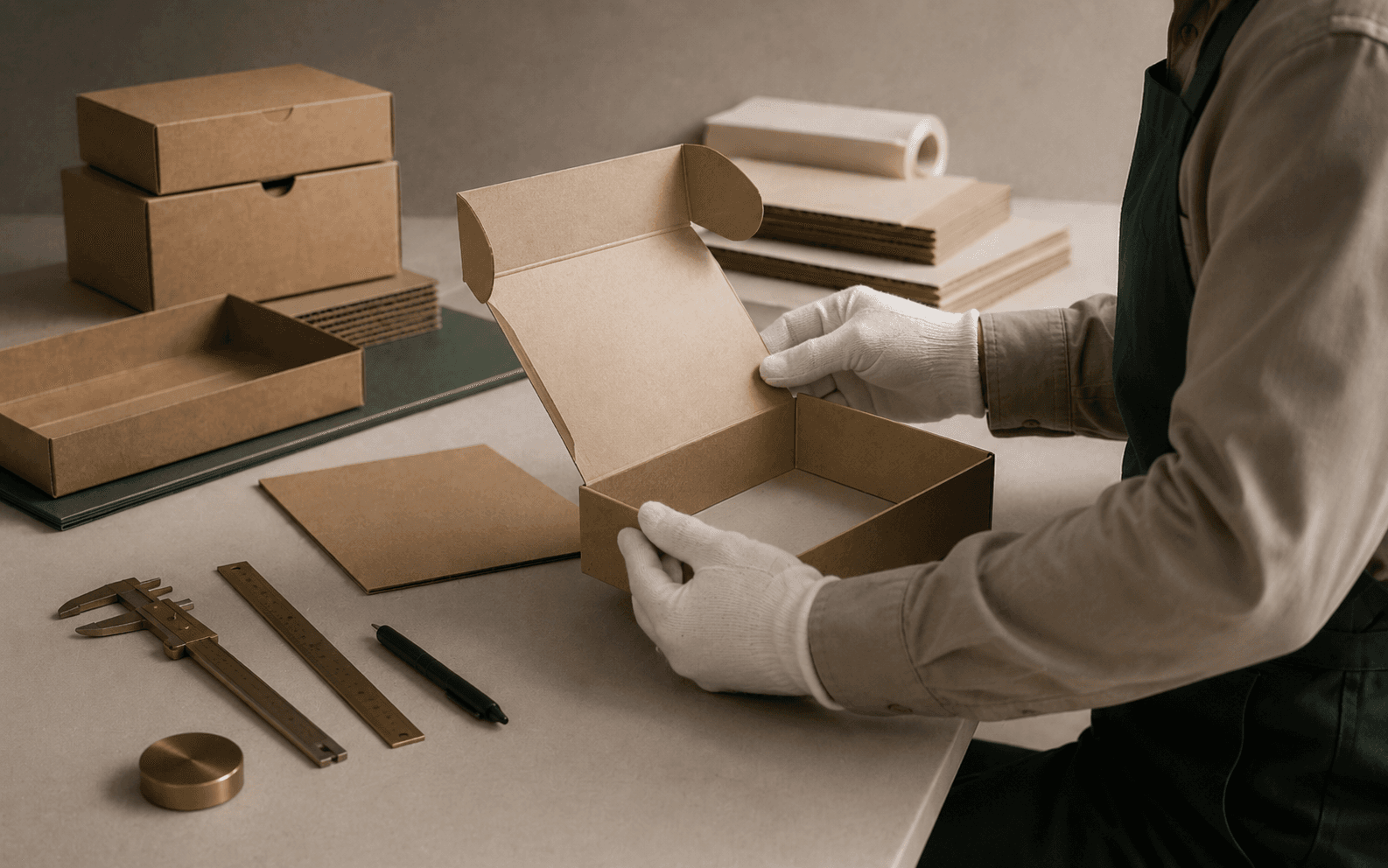
A box is not a zero-thickness outline. Board build, folds, scores, overlapping panels, inserts and product tolerance all affect the relationship between internal and external dimensions. A size stated before material and structure are selected is a starting requirement, not a final production dimension.

02

Internal and external size solve different questions

Internal dimensions describe the usable space for the product. External dimensions describe the finished pack envelope. State which one appears in every brief and drawing.

For fitted products, begin with internal requirements and show the product orientation. For shipping or shelf planning, external limits may also be essential.

03

Material occupies space

Every fold brings material into a corner or overlap. Corrugated profiles, paperboard thickness and mounted constructions create different relationships between the dieline and finished cavity.

Changing the board after a sample can alter both fit and outer dimensions, even when the nominal length, width and height are repeated.

04

Inserts and packing add another layer

An insert reduces the usable cavity and may elevate or rotate the product. Tissue, bags, boards and accessories also occupy space.

Product manufacturing tolerance and packing variation should be part of clearance review. Avoid a universal added margin that ignores the actual structure.

05

Confirm the size through a sample

Measure the sample using the agreed dimension convention, then pack the real product. Record adjustments on the current dieline revision.

The resulting internal and external dimensions apply to that confirmed structure and board, not to every material alternative.

Buyer checklist

Put these details in the brief

  • Internal or external dimension label
  • Product orientation
  • Selected board construction
  • Fold and overlap geometry
  • Insert/accessory space
  • Product tolerance and sample result

Buyer questions

Frequently asked questions

Should I send internal or external dimensions?
For product fit, internal dimensions are often the most useful starting point. State the dimension type explicitly.
Can I add a fixed allowance to the product size?
A fixed allowance is not reliable across structures, materials, inserts and product tolerances.
Why did the external size grow?
Board thickness, folds, overlaps and structural changes can increase the outside envelope while preserving usable internal space.

Project-specific confirmation

Turn this decision into a packaging specification.

Send the product, dimensions, quantity, artwork status and destination. Unknown details can remain “to be confirmed.”

Request a Custom Packaging Quote