
By / Published by: Foshan Kehong Paper Products Co., Ltd. · · Updated:
A smaller delivery volume and less work at receipt are different objectives. Compare them on the same design, quantity and work boundary before deciding which delivery state suits the operation.
Local comparison: carton volume and person-hours
1. Name the actual delivery state
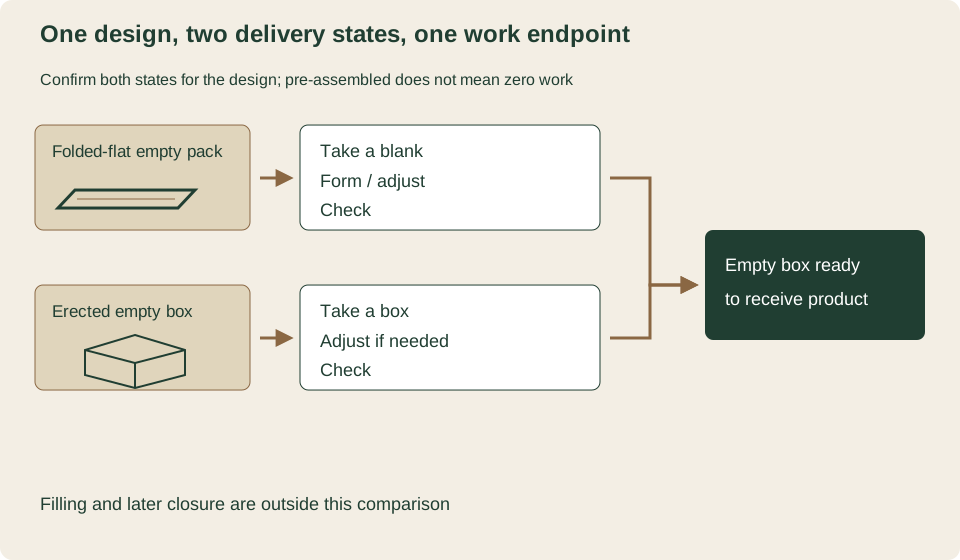
Flat-packed or folded-flat does not necessarily mean an unprocessed sheet. A carton may already be glued yet still arrive flat. FEFCO describes folding and gluing followed by flat shipment in corrugated converting; glued and erected are not interchangeable terms.
Here, pre-assembled means a three-dimensional empty box. It does not include filling products, order fulfilment or a third-party assembly service. The available state must be confirmed for the specific project.
2. Establish a comparable design first
Compare the two states only when the same design has been confirmed as suitable for both. Keep material, finished dimensions, print and included components constant. If one option changes the box style, list it as a separate design rather than treating delivery state as the only difference.
Record carton quantities, measured outside carton sizes, gross mass and the source of each estimate. A structure that cannot fold flat should not be forced into this comparison.
3. Stop both work paths at the same endpoint
The endpoint is an empty box ready to receive the product. List the remaining receiving-side actions: taking a box from its shipping case, forming it where required, adjusting it and checking readiness. Do not assume pre-assembled boxes require zero work.
Product filling, final closure and other shared later tasks sit outside this limited comparison. Use the same operating conditions and count the actions included in the timing.
4. Fill the project table, then inspect the teaching example
Use the blank record for real project information. Keep its unknowns separate from the deliberately hypothetical numbers below.
Blank comparison record
Same design / revision: ______________________
Confirmed delivery states: ___________________
Common work endpoint: ready-to-fill empty box
Quantity and unit: ___________________________
For EACH state, record:
Shipping carton type / quantity / boxes per carton: ____
Measured outside carton L × W × H + unit: _____________
Gross mass + unit: ___________________________
Remaining actions / one-person seconds per box: _______
Data source / measurement conditions / date: __________
Unknown costs / excluded actions: ____________________
| Input or result | Flat-packed | Erected empty boxes |
|---|---|---|
| Empty boxes | 1,000 | 1,000 |
| Assumed boxes per shipping carton | 100 | 25 |
| Assumed shipping-carton outside size (cm) | 60 × 40 × 40 | 60 × 40 × 40 |
| Shipping cartons | 10 | 40 |
| Total outside carton geometry (m³) | 0.96 | 3.84 |
| Assumed remaining seconds per box, one person | 36 | 9 |
| Corresponding operating person-hours | 10 | 2.5 |
| Gross mass, freight, labour charges and other costs | Unknown; excluded | Unknown; excluded |
Every carton quantity, dimension and time input in this example is invented to demonstrate the calculation. These are not a packing plan, a time standard or Kehong operating data.
Full cartons F = floor(N / q); remaining items R = N - F × q. Total cartons = F plus one when R > 0. With no tail carton, volume is F × full-carton volume. For an explicitly same-sized tail carton, use (F + 1) × full-carton volume. With a separately measured tail carton, add its outside volume to the full-carton total. If tail dimensions are unknown, show only the known full-carton portion and leave total volume unknown. If there are no full cartons, use only the actual tail-carton dimensions.
Cartons = quantity ÷ boxes per carton, rounded up. Total outside carton geometry = sum of each carton's outside length × width × height, all in metres. Receiving operation person-hours = quantity × one-person seconds per box ÷ 3,600.
For example, 10 × 0.60 × 0.40 × 0.40 = 0.96 m³, while 40 such cartons total 3.84 m³. The assumed operating times give 1,000 × 36 ÷ 3,600 = 10 person-hours and 1,000 × 9 ÷ 3,600 = 2.5 person-hours. Calculate different carton types and final partial cartons separately in a real project.
Under these assumptions only, the flat-packed state has less outside carton geometry and the erected state has fewer remaining receiving-side person-hours. Person-hours are not a delivery deadline or the elapsed duration of a multi-person operation. Rework, waiting and handling not included in the stated actions are not estimated.
5. Choose for the constraint, not a universal winner
A team short of receiving labour may evaluate the two states differently from a team with little storage space or a different packing rhythm. Put volume, remaining work, gross mass and confirmed costs side by side. Without cost inputs, do not calculate a total cost or declare one option cheaper.
Outside carton geometry is not warehouse floor area or a carrier's billable volume or weight. Pallets, stacking conditions and the actual transport service need separate confirmation. UPS distinguishes actual and dimensional weight; the cubic metres here cannot replace a service-specific freight calculation.
6. Why can a lighter shipment have a higher billed weight?
Transport uses both carrying capacity and space. For a service that applies dimensional weight, the carrier converts the outside shipping-package dimensions to a weight and compares it with gross weight under that service's rules. A light load in an oversized carton may therefore be billed above its scale weight. DHL Express and FedEx describe this comparison; it is not one rule for every transport mode.
For each delivery option, measure the sealed shipping-carton's outside dimensions and gross mass; list different carton types and the final partial carton separately. Product-fit internal dimensions and product net mass cannot replace those measurements. Confirm the carrier, service, route, dimensional factor, units and rounding from the applicable rule or dated quote. Do not assume a universal divisor such as 5000 or 6000, or combine all cartons before comparing weights unless the service allows it.
The delivery tool above calculates carton geometry and operating person-hours, not freight. Smaller geometry alone proves neither lower freight charges nor adequate protection. Use the shipment scope checklist in the buyer FAQ below to keep measurements, service rules and unknowns together before comparing quotations.
Technical references
Describe the options you need to compare
Start with the product, intended use and open questions. Confirm the structure and delivery state for the project.
Discuss the options